Understand health
QRISK: how it works and what your score means

Having calcium deposits in your coronary arteries indicates fatty material has built up, meaning you could have coronary heart disease and are at risk of heart attack. Professor Catherine Shanahan explains what your calcium score means and how healthy lifestyle and treatments can help lower your risk.


Calcification of the arteries is a condition where calcium builds up in your heart’s main arteries – the coronary arteries – which is why it is also called coronary artery calcification.
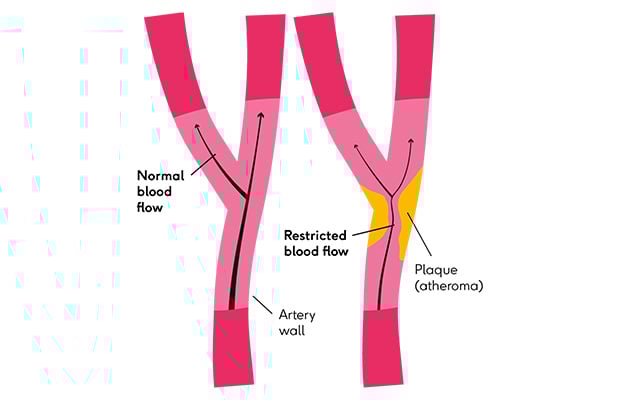
It’s a sign that fatty material has built up in these blood vessels – a process called atherosclerosis – which is commonly present if you have coronary heart disease and puts you at increased risk of a heart attack.
A heart attack happens if a piece of the fatty material breaks off and a blood clot forms around it, blocking the flow of blood and oxygen to your heart. This damages the heart muscle and can be life threatening.
Calcium deposits in your arteries are not related to your diet. They occur because the cells in your coronary arteries are not working as they should, which can be a sign of heart disease, or that you are simply getting older.
Studies have shown that these calcium deposits form because muscle cells in the coronary artery walls, which allow them to contract and expand, start to change into bone-like cells when they’re diseased or old. These bone-like cells are hard wired to deposit calcium.
Yes, the term ‘hardening of the arteries’ is used when talking about calcification of the arteries.
But it is a little more complicated than that, as there are two main ways calcification can affect your artery walls:
These 2 types of calcification can happen separately or at the same time.
Both stiffen the artery walls, making it harder for the blood vessel to expand and contract and pump blood around your heart. This can increase your risk of heart issues and can also result in less blood getting to your heart muscle.
This article is focused on the atherosclerosis type of calcification.
A CT scan is used to see how much calcium is in the fatty plaques in your coronary arteries, which indicates how much atherosclerosis you have.
This is important because how much calcified plaque you have in your arteries is one of the strongest indicators of your risk of having a heart attack in the future.

If the CT scan finds calcified plaques in your coronary arteries, it means you likely have coronary heart disease.
Guidance from the National Institute for Health and Care Excellence (NICE) says you should be offered a CT scan to find out if you have calcified plaques if you have chest pain (angina) – a key symptom of coronary heart disease – and if your doctor has assessed your likelihood of having coronary heart disease to be between 10 per cent and 29 per cent.
Knowing the amount of calcified plaques in your coronary arteries helps doctors decide the best course of treatment to prevent a heart attack
If your scan shows you have calcium plaques, you might be given a number called a ‘calcium score’ (also known as an Agatston score). This indicates the amount of calcium deposited in your coronary arteries.
This score ranges from zero to 1,000 – any number above zero means there are some signs of coronary heart disease.
The score is important because the higher your calcium score, the higher your risk of having a heart attack in the next 5 years.
Research shows that even if you do not have any other symptoms of coronary heart disease, like chest pain (angina), having a calcium score of over 300 means you are 7 times more likely to have a heart attack, or die from coronary heart disease, than someone with no coronary artery calcification.
However, not all fatty plaques contain calcium, which is why doctors also do other assessments to work out your risk of having coronary heart disease.
If your calcium score is between 1 and 400 you will offered a CT coronary angiogram to further investigate the extent of your coronary heart disease. And if it’s over 400 you may be offered an invasive coronary angiogram, according to NICE guidance.
These investigations will help doctors see if your coronary arteries are being narrowed by the build up of fatty plaques, which indicates you are at further risk of a heart attack.

There is no treatment that can reverse your level of coronary artery calcification. But there are lifestyle changes and treatments that can slow its progression and help reduce your risk of a heart attack.
If you have no other symptoms or risk factors for coronary heart disease, like chest pain (angina), then your medical team will advise you to have a healthy lifestyle.
This involves regular physical exercise and a healthy diet low in saturated fats, sugar and salt, quitting smoking and limiting the amount of alcohol you drink. These simple lifestyle changes can go a long way to slowing down your risk of heart attack.
If you have other risk factors for heart attack – like high blood pressure, high cholesterol, obesity and diabetes – then your doctor will also prescribe medicines to help lower these risk factors.