Eat well
Why am I not losing weight?

Find out how to calculate your body mass index (BMI) and what a healthy BMI is with our chart you can download and print. It also comes with a diary so you can keep track of your BMI over time.

Your BMI (body mass index) is your weight divided by your height multiplied by itself.
You can download or print our BMI chart (pictured below) to work it out:
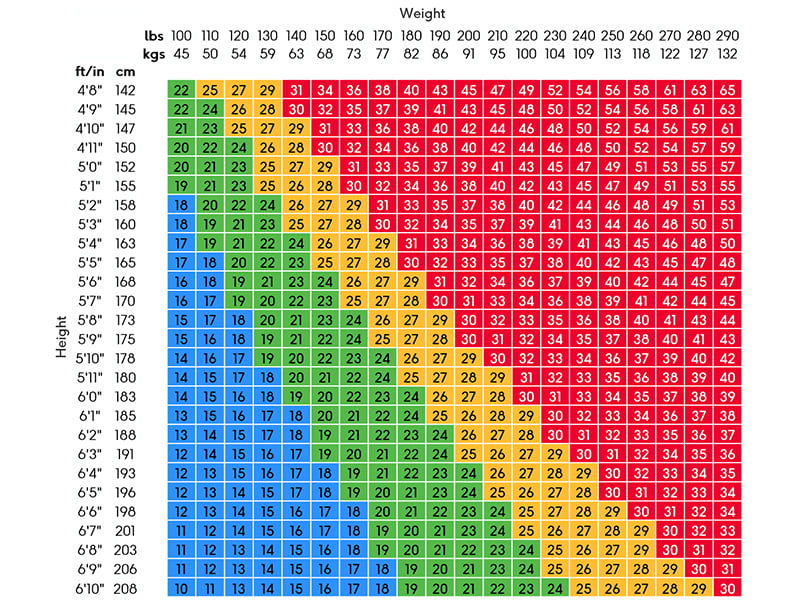
Standard BMI chart for UK.
Your BMI will be classed as 1 of 4 categories:
Category |
BMI |
Chart colour |
| Underweight | Under 18.5 | Blue |
| Healthy weight | 18.5 to 24.9 | Green |
| Overweight | 25 to 29.9 | Yellow |
| Obese | 30 and above | Red |
If your BMI is classed as overweight, you have a higher risk of developing cardiovascular disease and having a life-threatening event, such as a heart attack or stroke.
If your BMI is obese, you’re at an even higher risk.
If your BMI is underweight, you may have a greater risk of health problems too. Speak to your GP if your BMI is classed as overweight, obese or underweight.
People from different ethnic groups store body fat in different ways.
This means people from an Asian, Black African, African-Caribbean or Middle Eastern ethnic background may have a higher risk of health problems at a lower BMI.
You can download or print our BMI chart (pictured below) to work out your risk.
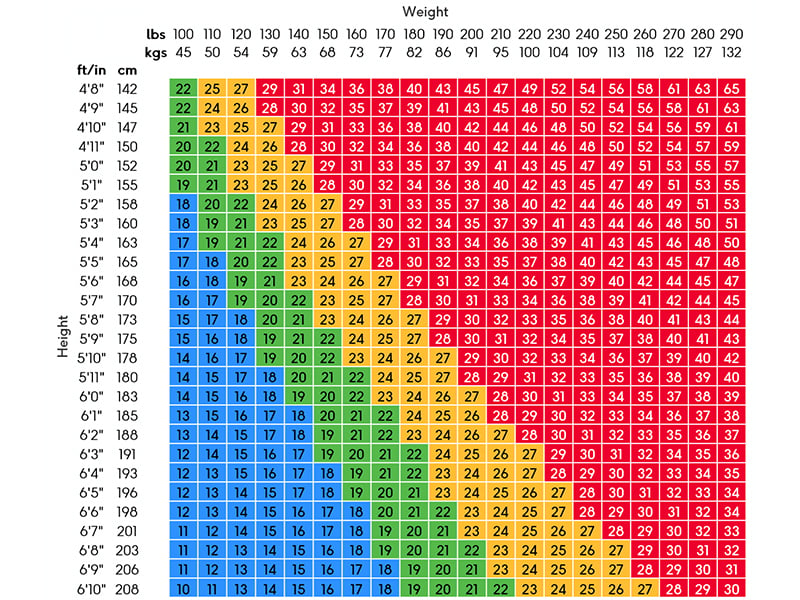
BMI chart for people from an Asian, Black African, African-Caribbean or Middle Eastern ethnic background.
Category |
BMI |
Chart colour |
| Underweight | Under 18.5 | Blue |
| Healthy weight | 18.5 to 22.9 | Green |
| Overweight | 23 to 27.4 | Yellow |
| Obese | 27.5 and above | Red |
However, the categories of ethnic backgrounds are broad as there’s less research on people from mixed backgrounds. That's why it may help to look at other measures alongside BMI too.
BMI alone does not determine your risk of cardiovascular disease. This is because it does not measure where fat is in the body and cannot tell the difference between fat and muscle. BMI is inaccurate for:
Excess fat around the waist can also increase your risk of cardiovascular disease, even if your BMI is healthy. Working out your waist-to-height ratio may be a more accurate tool and it’s suitable for all ages and ethnicities.
Download or print our BMI tracker to see how your BMI changes over time. You can monitor your BMI by taking measurements and writing them down in this diary every 3 months.
Try to weigh yourself at the same time of day, under the same conditions and on the same set of reliable scales.