Eat well

How to measure your waist and body fat
Excess body fat can put your health at risk, especially if it sits around the middle. BHF Senior Dietitian Tracy Parker explains how to measure your waist to height ratio to check whether you may be carrying too much fat around your belly.
Page updated:
Page updated:
Living with excess weight and obesity can increase your risk of heart problems. But it’s not just the number on the scales that counts.
There's a difference between your total body weight – which includes fat, muscle and bone mass – and your body fat.
Having a lot of fat compared with muscle and bone can have a negative effect on your health.
Where the fat sits in your body is important too. For example, fat around your belly (abdomen) is linked to higher risks of cardiovascular disease and type 2 diabetes.
There are a few types of fat around the belly:
- Subcutaneous fat sits under the skin. This is the fat you can feel.
- Visceral fat builds up around your organs. It’s linked to high cholesterol, high blood pressure and type 2 diabetes.
- Ectopic fat builds up inside your organs. This can also pose a risk to your health. For example, a liver with excess fat can release too much fat and sugar into your blood, increasing your risk of coronary heart disease and type 2 diabetes.
You cannot measure how much fat sits around and inside your internal organs at home.
However, you can measure your waist size to find out if you're carrying too much weight around your middle.
What is the waist to height ratio?
The National Institute for Health and Care Excellence (NICE) recommends using the ‘waist to height ratio’ to find out how much fat is stored around the belly in adults with a BMI (body mass index) below 35.
This compares the size of your waist (the circumference) to your height.
The more excess fat you have around your belly, the higher your waist to height ratio will be, and the greater your risk of health problems, such as having a heart attack or stroke.
However, if you have a larger body size or your belly hangs down over the lower abdomen, it may be difficult to position the tape or find the right point to measure your waist.
Speak to a healthcare professional if you cannot measure your waist accurately or your BMI is 35 or above.
They can consider your BMI alongside a clinical assessment, which may include checking your blood pressure, rather than relying on your waist size alone.
How to measure your waist

Watch our short video to learn how to measure your waist.
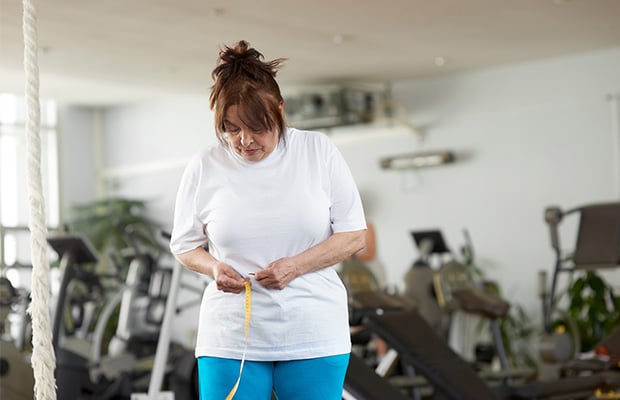
- Find the bottom of your ribs and the top of your hips.
- Wrap a tape measure around your belly at the halfway point between them.
- Pull it snug, without letting it dig into your skin.
- Breathe out naturally and make a note of where the tape measure reaches all the way around. This can be in inches or centimetres.
How to work out your waist to height ratio
To work out your waist to height ratio, measure your height in the same unit as your waist (inches or centimetres), then divide your waist measurement by your height.
For example, if your waist size is 96.5cm and your height is 170cm, you need to divide 96.5cm by 170cm, which equals 0.57. This is your waist to height ratio.
If your calculation is 0.5 or more, this means your waist is more than half of your height and and you may benefit from losing weight to reduce your risk of cardiovascular disease.
Waist to height ratio |
What it means |
|---|---|
| 0.4 to 0.49 | Healthy range |
| 0.5 to 0.59 | Increased risk of health problems |
| 0.6 or above | Highest risk of health problems |
The 'string test’
If you do not have a tape measure, you can use a piece of string instead:
- Use the string to measure your height from the bottom of your feet to the top of your head. You may need to ask someone to help you.
- Cut or mark the string to the same length as your height and then fold it in half.
- Wrap the folded string around your waist following the same steps as with a tape measure.
If you cannot completely wrap the folded string around your waist, your waist is more than half of your height. This means you may be carrying too much fat around your waist.
What is a healthy body fat percentage?
Your body fat percentage is the proportion of your total body weight that's made up of fat.
We all need some fat for good health, but a higher body fat percentage increases the risk of cardiovascular disease.
So, while you may have a healthy BMI, if more of your weight is made up of fat, you could still be at risk of health problems.
There’s no specific recommended range, as a healthy body fat percentage varies depending on your age and sex.
But if you're interested in finding out the percentage of your weight made up of fat, there are a few tools you can use.
However, the method you use can affect your reading, as well as how hydrated you are when you measure yourself.
Plus, many methods do not tell you where your body stores fat, which is why working out your waist to height ratio is more useful for most people.
4 more ways to check body weight and fat
1. Body mass index (BMI)
Your BMI uses your total body weight and your height to work out if you’re a healthy weight.
However, your BMI cannot tell the difference between muscle and fat or where fat is located in your body.
It may be misleading for older people, people with a lot of muscle and during pregnancy.
- Find out if you have a healthy BMI with our downloadable chart.
2. Callipers
Skinfold callipers measure fat underneath the skin (subcutaneous fat) at certain places on your body. These are known as skinfold measurements and you can use them to estimate your percentage of body fat.
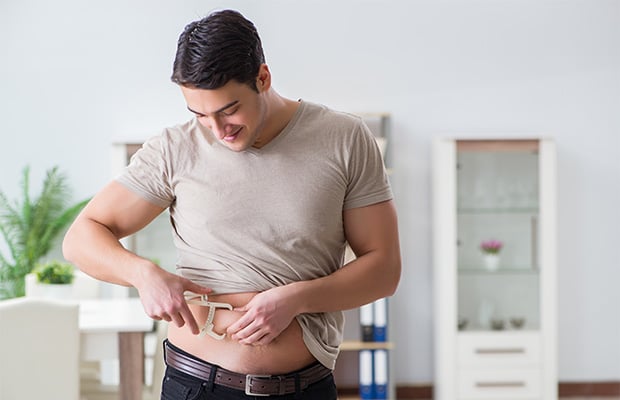
A set of callipers usually costs £4 to £10 online, so it's a relatively cheap way to measure body fat.
You can use the measurements to track body fat over time. If your skinfold thickness is going down, then you’re probably losing fat.
However, they cannot tell you how much fat sits around and inside your organs.
And callipers may not always be reliable and can be tricky to use, with some sets more accurate than others.
3. Smart scales
You can use smart scales, often found at gyms, to work out how much of your weight is made up of body fat. However, do not use smart scales if you have a pacemaker.
Smart scales look like regular scales with foot plates and may have additional hand plates. They use a process called bioimpedance that sends tiny electrical impulses through the body and measures how quickly they return.
The electrical current flows more easily through parts of the body mostly made up of water, such as muscle and blood, compared to fat or bone.
The amount of water in your body can affect the reading, so stay hydrated by drinking regularly throughout the day, and avoid drinking a large amount just before using smart scales.
For more consistent results, use them at the same time and under similar conditions, for example in the morning before breakfast, and follow the manufacturer’s instructions about eating, drinking, exercise, alcohol and caffeine beforehand.
While some smart scales can be pricey, you can buy cheaper models from around £25 or check to see if your local gym has some you can use.
You can also find a range for sale on the British Heart Foundation online shop.
4. DEXA scans
DEXA (dual energy X-ray absorptiometry) is more commonly used to assess bone density, but it can also be used to measure body fat.
It can tell you how much fat you’re carrying and how it’s distributed around your body.
You can access a DEXA scan at private clinics around the UK, but a scan usually costs at least £100.
If you’re living with excess weight or obesity, visit our Healthy Living hub or speak to your doctor for more support with managing your weight.
What to read next...