

Pacemaker could help reverse heart failure symptoms by switching heart's fuel from sugar to fat

A pacemaker could help reverse symptoms of heart failure by encouraging the heart to use more efficient fuel, according to new research funded by us and published in the European Heart Journal.
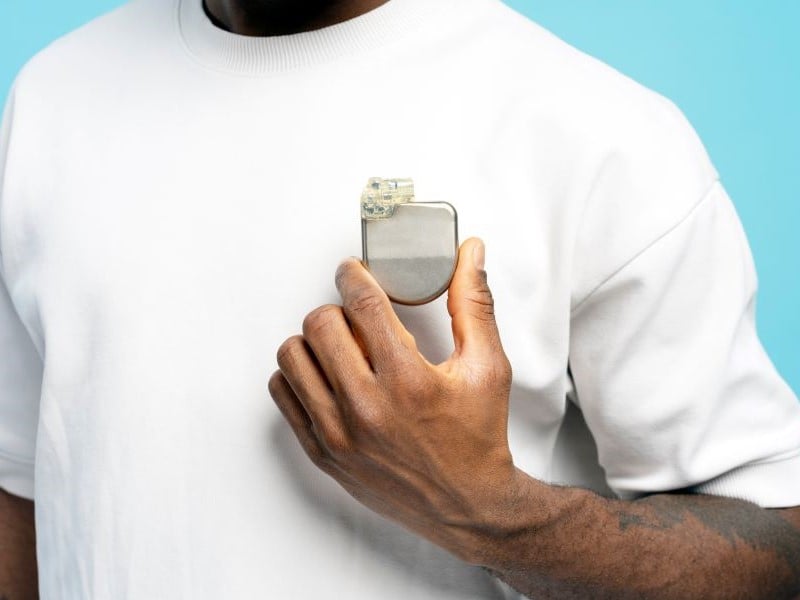
A device called a cardiac resynchronisation therapy (CRT) pacemaker, can switch the heart’s fuel from sugar to fat after only two minutes, a study has found.
It’s estimated that more than a million people in the UK have heart failure. It can leave people breathless, tired and struggling with everyday tasks, as their heart cannot pump blood around the body properly.
In heart failure, the heart no longer uses fat as the main fuel to keep it beating. Instead, glucose becomes its preferred fuel, researchers have found.
Stronger heartbeat
The team set out to investigate whether they could switch the fuel back from glucose to fat, based on evidence that hearts using fat as their energy source have a stronger heartbeat.
The study, led by the University of Oxford, involved 14 people with heart failure who were due to have a CRT pacemaker fitted, to see if it could switch their heart’s fuel back to normal. People in the study had a mixture of glucose and fat injected into their bloodstream, with an MRI scan showing how the heart took these up.
Improved by over a third
After only two minutes of the pacemaker being turned on, people’s hearts changed back from using glucose to using fat. After six months, the main pumping chamber of the heart – the left ventricle - had reduced in size by an average of 50 per cent in study participants. The study also found that the pumping function of the heart, how well it was able to squeeze blood out to the rest of the body, improved by over a third.
Patients in the study also reported feeling less breathless after having the pacemaker and were more mobile, while experiencing less pain and discomfort and lower average levels of anxiety and depression. This was based on people’s responses to a questionnaire, although researchers say more evidence is needed from a larger group of people to confirm the findings.
Beat more efficiently
Pacemakers are used to correct abnormal electrical signals in the heart, and are typically given to people who have irregular heartbeats, which can be caused by a number of conditions, including heart failure. Unlike traditional pacemakers which work to keep the heart from beating too slowly, CRTs additionally help to re-coordinate the pumping action of the heart to help it beat more efficiently. They can be helpful for people with a type of heart failure where one wall of the heart contracts as the other relaxes, so that blood is not pumped out.
The researchers believe CRTs may also restore a signal for the heart to use fat for fuel, which is lost in some people with heart failure, because the electrical signals in their heart, which trigger each heartbeat, have slowed down. When the heart reverts to its correct fuel, it may then start to recover, researchers suspect.
The team behind the study suggest that looking at how people with heart failure respond to glucose or fat could help doctors spot those that would benefit the most from having a CRT pacemaker. Meanwhile, those whose hearts have switched less dramatically to using glucose could be signposted instead towards lifestyle changes or medication.
"New treatment approaches"
Dr Sonya Babu-Narayan, our Clinical Director, said: "This early-stage study involving cardiac resynchronisation devices - specialised pacemakers which coordinate the heart’s pumping chambers to improve its overall function - is intriguing. The findings suggest these devices can trigger failing hearts to resume using fat as their primary fuel—mirroring the metabolism of healthy hearts. Although this study involved only a small number of patients, if the results are confirmed in larger, longer-term studies, they could point to new treatment approaches for heart failure that target the heart's energy source.”
"Remarkable"
Professor Neil Herring, Professor of Cardiovascular Medicine at the University of Oxford, said: “The size of the improvement we’ve seen in the hearts in our study in response to CRT is remarkable. The slowing down of electrical signals in the heart, in some people who have heart failure, may mean the signal for the heart to use fat for fuel is lost, and their heart switches to using glucose instead. A pacemaker restores the “use fat for fuel” message through fixing the signalling problem as it regulates the heart. This then helps the heart to start to recover.
“Through this research, we have identified a new pathway that we can harness to help the millions of people in the UK who live with heart failure. This is a vital step to understanding how we can bring forward a new age of therapies.”