

‘Invisible’ heart condition disproportionately affecting women is focus of major new global research programme

We're excited to support a new $55m global research programme called VISIBLE from Wellcome Leap - jointly funded by Pivotal - to improve women's heart health.
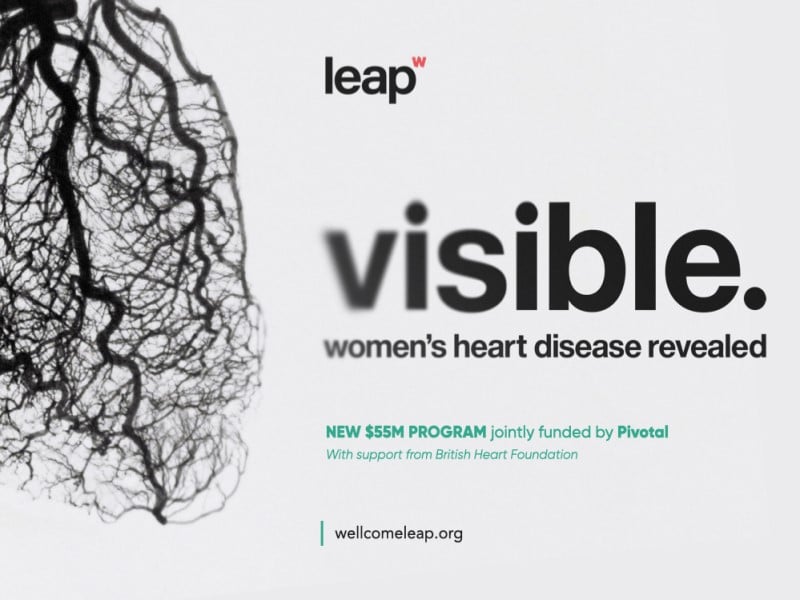
Over 300 million women worldwide live with cardiovascular disease, and it’s the biggest killer of women globally. Yet for many, the disease remains undetected.
At least 60 million women globally live with stable chest pain, known as angina (1-2). However, each year, a subset of these women undergo invasive heart tests called angiograms and leave without a diagnosis. They may be told their arteries look “normal”, that their hearts are healthy, and that it might be anxiety.
In people with stable angina, the most common diagnosis is coronary heart disease due to a blockage or narrowing in a major coronary artery, so medicine has spent decades learning to find and fix these obstructions.
But two out of three women with stable angina who undergo a coronary angiogram don’t have any obvious problems like blockages in their arteries (3-5).
They have what’s known as ANOCA (angina with no obstructive coronary arteries). In most of these women, ANOCA is caused by disease in the heart's smallest blood vessels, known as coronary microvascular disease (CMD), though there are other causes such as coronary vasospasm. It doesn't show up on angiograms, which means it is often missed.
The result of healthcare systems set up to find blockages in the main coronary arteries is a diagnostic odyssey, leaving a population – mainly women – without answers.
Profound consequences
The consequences are profound. Seven in 10 women with ANOCA report adverse effects on mental health, and eight in 10 report impacts on their social lives (6).
Seven in 10 report adverse effects at work, with many reducing hours, retiring early, or moving into lower-paid roles (6).
The economic cost is equally staggering – healthcare systems spend thousands per patient on tests designed to detect blockages that aren’t there (7).
VISIBLE aims to change this reality. Its goal is to increase the proportion of women presenting with stable angina who receive effective diagnosis and treatment for coronary microvascular disease – from less than an estimated 1% to more than 80% (8).
VISIBLE aims to demonstrate advances capable of reducing the burden of cardiovascular disease for millions of women worldwide.
We’re proud to contribute £5m to this programme led by Wellcome Leap, a billion-dollar research funder, jointly funded by Pivotal Ventures, a group of organisations founded by Melinda French Gates to accelerate social progress for women and young people.

Dr Charmaine Griffiths with Dr Regina Dugan
Commenting on the launch of VISIBLE, our Chief Executive Dr Charmaine Griffiths said: “We will never accept that the world’s leading killer of women is still shrouded in unanswered questions. Understanding cardiovascular disease in half the population is not just science - it’s a moral imperative. Women deserve better.
“Together with Leap and Pivotal, we can dare to dream of giving the next generation of mothers, grandmothers, sisters and daughters the chance to lead longer, healthier lives by unlocking scientific breakthroughs sooner than ever thought possible."
Dr Regina Dugan, CEO of Wellcome Leap, said: “Heart disease is the number one cause of death for women globally.
“Countless women suffering from this disease leave their doctor's office told their hearts are healthy. That it might be anxiety.
“For these women, what we don’t see matters. The vast majority of the heart's vascular system – the coronary microvasculature – is rarely evaluated, yet it controls 80% of blood flow to the heart muscle. This invisible network is costing women years, health, and lives.”
Innovative model
The programme will use Leap’s innovative research model -- designed to be fast, agile, and networked across disciplines, organizations, and countries. Its expert-designed, milestone-driven, three-year programmes are built to tackle urgent health challenges.
This proven approach to generating breakthroughs is modeled on the U.S. Defense Advanced Research Projects Agency (DARPA). In six years, Wellcome Leap has launched 14 programmes spanning 30 countries, powered by a growing network of more than 170 institutions, nonprofits, and companies – representing millions of researchers across six continents.
To date, Leap has invested over $250 million in accelerating women's health research. This includes a $100 million partnership with Pivotal, a group of organizations founded by Melinda French Gates, announced in September 2025. VISIBLE is the first of two women's health programmes jointly funded by Wellcome Leap and Pivotal.
References:
1) BHF analysis of World Heart Federation figures on estimated global angina prevalence: https://world-heart-federation.org/angina/
2) BHF analysis of Hemingway H, Langenberg C, Damant J, Frost C, Pyorala K, Barrett-Connor E. Prevalence of angina in women versus men: a systematic review and meta-analysis of international variations across 31 countries. Circulation. Mar 25 2008;117(12):1526–36. doi:10.1161/CIRCULATIONAHA.107.720953
3) Shaw LJ, Bairey Merz CN, Pepine CJ, et al. Insights from the NHLBI-Sponsored Women's Ischemia Syndrome Evaluation (WISE) Study: Part I: gender differences in traditional and novel risk factors, symptom evaluation, and gender-optimized diagnostic wellcomeleap.org wellcome-leap @wellcomeleap 13 strategies. J Am Coll Cardiol. Feb 7 2006;47(3 Suppl):S4–S20. doi:10.1016/j.jacc.2005.01.072
4) Jespersen L, Abildstrom SZ, Hvelplund A, et al. Burden of hospital admission and repeat angiography in angina pectoris patients with and without coronary artery disease: a registry-based cohort study. PLoS One. 2014;9(4):e93170. doi:10.1371/journal.pone.0093170
5) Patel MR, Peterson ED, Dai D, et al. Low diagnostic yield of elective coronary angiography. N Engl J Med. Mar 11 2010;362(10):886–95. doi:10.1056/NEJMoa0907272
6) Ranasinghe S, Merz CNB, Khan N, et al. Sex Differences in Quality of Life in Patients with Ischemia with No Obstructive Coronary Artery Disease (INOCA): A Patient Self-Report Retrospective Survey from INOCA International. J Clin Med. Aug 30 2023;12(17)doi:10.3390/jcm12175646
7) Shaw LJ, Merz CN, Pepine CJ, et al. The economic burden of angina in women with suspected ischemic heart disease: results from the National Institutes of Health--National Heart, Lung, and Blood Institute--sponsored Women's Ischemia Syndrome Evaluation. Circulation. Aug 29 2006;114(9):894–904. doi:10.1161/CIRCULATIONAHA.105.609990
8) Wellcome Leap estimate