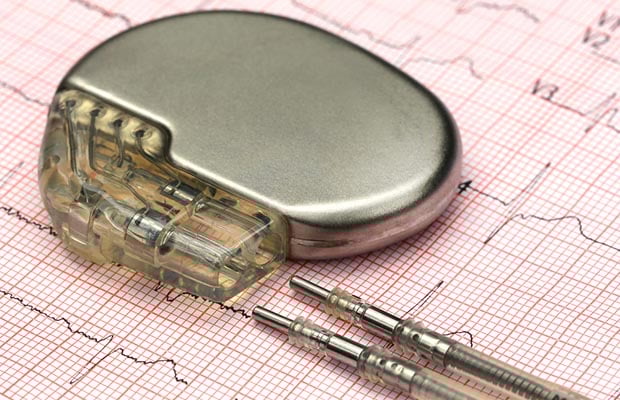
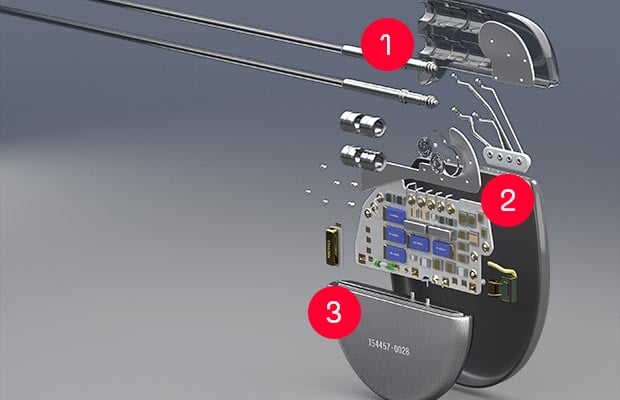
These leads are very thin, flexible, electrically insulated wires that are inserted into the vein at the top of the shoulder and travel inside it to go into chambers on the right side of the heart.
2. Pacemaker box
The leads are attached to a pacemaker box/generator that contains a battery and a small computer with some memory in it to record any heart rhythm abnormalities. The box sits in the upper left chest, below the collarbone. A pacemaker senses through its wires what the heart is doing. If it senses that the heart has slowed down or missed a beat, then it will send an electrical impulse to stimulate the heart to restore it to its normal rate.
3. Battery
The average lifespan of a pacemaker battery is about 6–7 years. There is plenty of warning before the battery runs out and patients are regularly checked towards the end of the battery life.
The procedure for changing the battery is much simpler than when pacemakers are put in. The wound is reopened and the pacemaker box is removed, but the leads stay in place. Most people go home the same day.
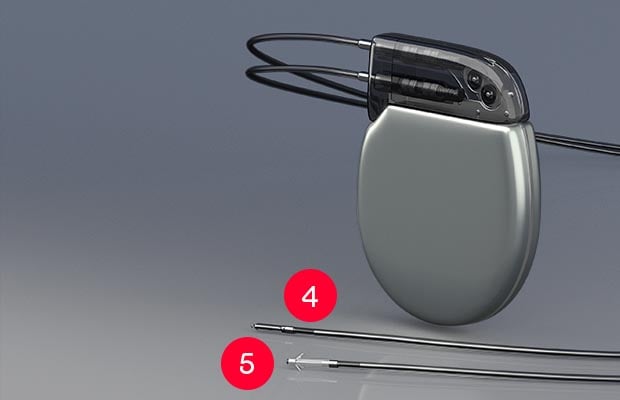
4. Electrodes
At the tip of each wire are electrodes. These are the contact points between the pacemaker and the heart – where the electrical signal is delivered from the pacemaker to your heart, and where the information about your heart’s signalling action is received and carried back to the pacemaker.
5. Barbs or screws
The leads are attached to the heart muscle by a tiny barb or small screw mechanism. Traditionally there will be one in the right ventricle and one in the right atrium.
To find out more, or to support British Heart Foundation’s work, please visit www.bhf.org.uk. You can speak to one of our cardiac nurses by calling our helpline on 0808 802 1234 (freephone), Monday to Friday, 9am to 5pm. For general customer service enquiries, please call 0300 330 3322, Monday to Friday, 9am to 5pm.
British Heart Foundation is a registered Charity No. 225971. Registered as a Company limited by guarantee in England & Wales No. 699547. Registered office at Greater London House, 180 Hampstead Road, London NW1 7AW. Registered as a Charity in Scotland No. SC039426