

Understand health
12 questions to ask your doctor

Tumours in the heart are rare, but spotting them early is important. BHF Professor Sven Plein talks to Senior Cardiac Nurse Emily McGrath about the symptoms and treatments for cardiac tumours.

Cardiac tumours are growths in the heart muscle or its adjacent structures. They are divided into benign (non-cancerous) and malignant (cancerous) tumours.
Benign heart tumours, while still relatively rare, are much more common than malignant cardiac tumours. They are called benign because they don’t spread to other areas, but can still grow large and in some cases block part of the heart or affect its structure, which can make the tumour difficult to extract. The most common benign tumour is atrial myxoma, but there are many other types including lipomas, fibromas, rhabdomyomas and papillary fibroelastomas.
Benign heart tumours, while still relatively rare, are much more common than malignant cardiac tumours
It’s very unusual for these to originate in the heart – they are more likely as a result of cancer that has spread from another organ.
Anyone can be affected, but overall they are rare. Atrial myxoma is most likely to affect women aged between 30 and 60. Malignant cardiac tumours most often affect people between 30 and 50 years old.
That depends on the location, size and type of the tumour. Some tumours cause no symptoms, and most others cause only non-specific symptoms. An atrial myxoma, for example, may cause sweating, high temperature, shortness of breath, dizziness, chest pain, palpitations or general fatigue. A malignant heart tumour can affect the heart in many ways and may cause symptoms relating to obstruction of blood flow in the heart or lead to a collection of fluid around the outer layer of the heart (the pericardium). This can lead to breathlessness, arrhythmias, blackouts and sometimes sudden death.
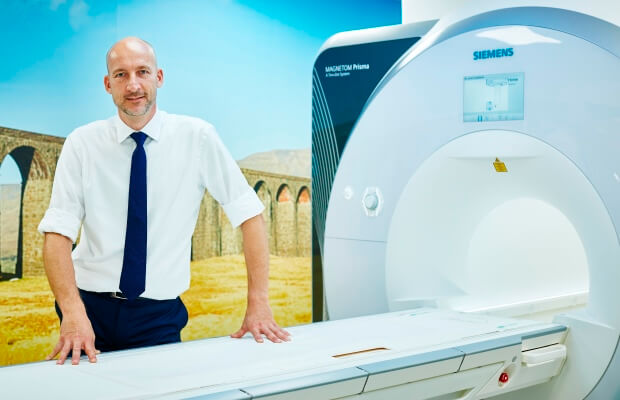
Professor Plein uses an MRI scanner to identify different types of tumour
Atrial myxoma is a benign tumour. It makes up around a quarter of all cardiac tumours and more than half of benign tumours. It typically occurs in the smaller, upper chambers of the heart (the atria). Parts of the myxoma or blood clot on its surface can break loose and cause blockages in an artery – this can lead to problems such as a stroke or a clot in the lungs (pulmonary embolism). Unlike other cardiac tumours, they can run in families. About 10 per cent of atrial myxomas are inherited.
Some benign tumours do not require treatment, but if they cause symptoms, they are generally removed through open heart surgery. For some tumours such as myxomas, the success rate is very high.
With any tumour, the earlier it is diagnosed the more likely it is that it can be removed and cured
For malignant tumours, medication, chemotherapy, radiotherapy and surgery could all be considered. Surgery can be more complicated, because as much of the tumour as possible needs to be removed and heart tissue may need to be reconstructed. In a few of the most severe cases, nothing can be done. With any tumour, the earlier it is diagnosed the more likely it is that it can be removed and cured.
Tumours are often detected by echocardiograms and CT scans, and the same tests are used to check on patients after they have had treatment. MRI scans are increasingly used to differentiate between the different types of tumour. A more detailed diagnosis involves opening the chest to take some tissue from the tumour (a biopsy).

