Get active
Video: 10-minute workout
Swimming is a great way to get fit and build strength. Lifelong swimmer Ivor Pope tells Rachael Healy about the benefits.

Ivor Pope is 81 and still swims regularly. “Right now, I’m swimming three or four times per week, for maybe 40 minutes at a time,” says Ivor. “I do backstroke – that’s my favourite, I love it – and front crawl. It keeps me strong.”
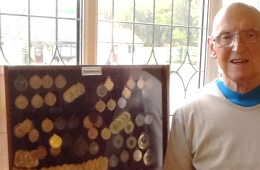
Ivor started swimming as a child in Swindon in the 1940s. Realising he was faster than the other children, he joined a club and went on to become county backstroke champion. Ivor (pictured right, with some of his medals) later became a European and Masters champion.
Now he swims for fun and to stay fit, and he can’t imagine stopping. “I don’t see a future for me without a nice coloured costume and a swim,” says Ivor.
Ivor’s love of the sport led him to open a swimming school in Hemel Hempstead with his wife, Ann. “All the family were good swimmers,” says Ivor. “We did lessons with our five children, and we had a swimming pool in our garden. We’d have all the family round. We have 13 grandchildren and they are all fantastic swimmers.”
Ivor and Ann retired from teaching after 14 years, but have plenty of wisdom to share. “Go gently,” says Ivor. “Make it something that you can build on. Perhaps you can only stay in for five minutes at first, but next time make it 10 minutes. Staff at the pool will help you.”
Swimming is a low-impact activity. This is good news if you’re worried about your joints, or find running, hiking and similar exercises uncomfortable. “It’s gravity-free, you have got the water supporting you,” Ivor explains.
In 2008, Ivor suffered a cardiac arrest in the pool. “The doctors told me it could have happened anywhere – there were no signs of the swimming causing problems,” says Ivor. The lifeguards performed CPR until paramedics arrived and restarted Ivor’s heart with a defibrillator.
It’s gravity-free, you have got the water supporting you
Ivor needed triple heart bypass surgery, and after his release from hospital he began swimming again as part of his cardiac rehabilitation. However, there were some restrictions to minimise strain on his breastbone. “I was forbidden from doing butterfly, which was one of my best strokes,” he explains.
Unfortunately, two years later, Ivor suffered a second cardiac arrest in the same pool. Again, by pure coincidence rather than as a result of his swimming. This time, a group of lifeguards taking part in a training session sprung into action. A defibrillator had been installed at the pool following Ivor’s first cardiac arrest. The lifeguards used this to save his life.
Ivor now has an implantable cardioverter defibrillator (ICD) to prevent further cardiac arrests and has been swimming without incident since 2010. “There are no signs of swimming causing any problems with my heart at all,” says Ivor. “When I’m in the pool I’m moving for 40 minutes or more and I never need to stop on the way.”
The couple have continued to find a welcoming swimming community at their local pool, the Swindon Link Centre. “Every time I go swimming I talk to somebody new,” says Ivor. “When I finish swimming the lifeguards always give us a wave and a smile and say goodbye.”