Understand health
How to choose a blood pressure monitor
Here's our guide to finding the best device for you, and how to use it to get accurate readings at home.
Page updated:

Page updated:
What's on this page
- Find the best blood pressure monitor for you
- 10 steps to taking an accurate blood pressure reading
- What is a normal blood pressure reading?
More than 1 in 4 UK adults have high blood pressure (hypertension), increasing their risk of heart attack or stroke.
But an estimated 5.4 million adults in the UK with high blood pressure could be undiagnosed. This is because there are usually no symptoms.
If you or your doctor think you may be at risk, you can easily keep an eye on your blood pressure by using your own monitor at home.
Find out how to choose the best machine for you to ensure accurate results.
Find the best blood pressure monitor for you
If your doctor has asked you to measure your blood pressure at home, they may be able to provide a monitor that you can borrow.
If you're buying your own device, the cheapest monitors start from around £20 and are available in most local pharmacies and larger supermarkets.
Here are a few ways to make sure your monitor is accurate and reliable:
- Get a monitor with an upper cuff: Ideally, choose a blood pressure monitor that measures your blood pressure at your upper arm. If you cannot use a cuff on your upper arm, you can use a cuff that wraps around your wrist instead.
- Make sure the cuff is the right size: The cuff should wrap snugly around your upper arm, with just enough space to slide 2 fingers underneath. Most home blood pressure monitors will come with a medium-sized cuff. If your upper arm is much larger or smaller than average, you may need to buy a different sized cuff separately.
- Decide how to record your results: Keeping a note of your readings can help you track your blood pressure over time. If you want to, you can buy a device with a memory to store your results. However, these often cost more than other monitors, and recording your readings with a pen and paper in a diary can work just as well.
- Check if it’s UK approved: Choose a monitor that has been validated by the British and Irish Hypertension Society (BIHS). This means that it has gone through a series of tests to check it gives results that you can trust.
- Get it serviced every 2 years: Your blood pressure monitor needs to be serviced and calibrated at least once every 2 years to make sure it’s accurate. This involves sending it back to the company who made it, usually for a fee. If this option is too complicated or expensive, it may be easier and cheaper to buy a new monitor.
10 steps to taking an accurate blood pressure reading
- Make sure you’re feeling calm and not anxious or stressed.
- Sit upright with your back against the back of your chair and feet flat on the floor.
- Rest your arm on a table and make sure your hand is relaxed. Do not clench your fist while you’re taking your blood pressure.
- Place the cuff over your upper arm with the tubing leading down the centre or slightly to the right of your arm.
- Tighten the cuff around your arm, making sure you can still fit 2 fingers underneath.
- Press the 'On' button on your monitor, and then press the 'Start' button. Do not talk and try to relax.
- You’ll feel the cuff inflate automatically, quite quickly, and then deflate again. It may feel a bit tender or uncomfortable, but this will only be for a short period of time. If it's too uncomfortable, you can press the ‘Stop’ button and the cuff will instantly deflate.
- Once you get your reading, make a note of it. Some machines also come with a printer, so you can stick your print-outs in a diary if you'd like to.
- Check your blood pressure again a few minutes later, to make sure the readings are similar and accurate.
- If you’ve been asked by your GP or nurse to check your blood pressure, take it twice a day – morning and evening – and then make an appointment to discuss the results.

Watch our short video explaining how to take your blood pressure at home
What is a normal blood pressure reading?
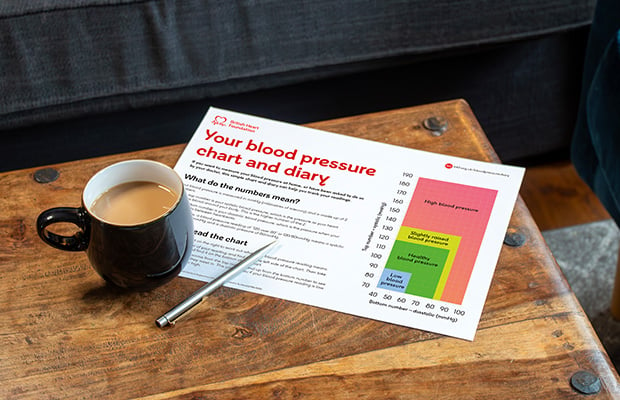
Once you have your monitor and you know how to use it, you can check if your blood pressure is in a normal range.
- Normal blood pressure: between 90/60 mmHg and 120/80 mmHg.
- High-normal blood pressure: between 120/80 mmHg and 140/90 mmHg - this suggests that you may be at risk of high blood pressure.
- High blood pressure: over 140/90 mmHg.
If you're over 80 years old, anything under 145/85 mmHg is ideal. This is slightly higher because your arteries get stiffer as you age.
What to read next...
Are your blood pressure readings wrong?

More useful information
Real life stories
Living with high blood pressure: Joyce's story

Understand health
Blood pressure chart and diary